From concept to launch, we deliver exceptional websites
using a comprehensive,
user-centric approach. Our focus on intuitive design and
agile methodologies ensures
solutions that surpass expectations. We create
responsive, SEO-friendly websites that
captivate and engage visitors.
Our expert team leverages cutting-edge technologies to
develop high-performance apps for
iOS and Android. We prioritize user experience and
functionality, crafting mobile solutions
that captivate and retain users.
We design scalable, tailored cloud solutions to meet your
business needs, ensuring
efficiency and cost-effectiveness. Our cloud services
optimize your operations with secure,
reliable, and flexible infrastructure.
We build robust, scalable e-commerce solutions customized
to your brand. Our platforms
are designed to enhance user experience, boost sales,
and elevate your online presence
Our intelligent solutions provide valuable insights,
automate processes, and deliver
personalized user experiences. We harness the power of
data to drive innovation and
efficiency in your business.
We connect the physical and digital worlds by creating
IoT solutions that enhance
connectivity and streamline operations. Our developments
improve efficiency and offer
real-time data insights.
Arabic App Development in UAE: Complete Cost & Compliance Guide for 2026
9 March, 2026Last Updated
13 minutesRead
74Views
A food delivery app launched in Dubai last year with a clean design, smooth checkout, and reliable delivery. The product worked well technically. But it supported only English. Users downloaded the app, opened it once, and never returned. Local restaurants hesitated to join. Investor discussions shifted from growth plans to market readiness.
The team later added Arabic language support, but the delay cost them. The update required AED 75,000 and nearly six months of additional development. That time and budget could have gone into marketing, partnerships, and improving the service instead of rebuilding core parts of the app.
This situation is common for apps entering the UAE market. Arabic app development in the UAE isn’t an optional feature added later. It shapes user trust, business partnerships, and approval processes from the beginning. Getting these foundations right early helps teams launch faster, reach more users, and avoid expensive corrections after release.
Table of Contents
Why Arabic Matters More Than You Think?
Dubai feels international. Abu Dhabi has expats everywhere. English works fine for daily life. So why does Does Arabic matter so much for apps? The answer goes deeper than you’d expect.
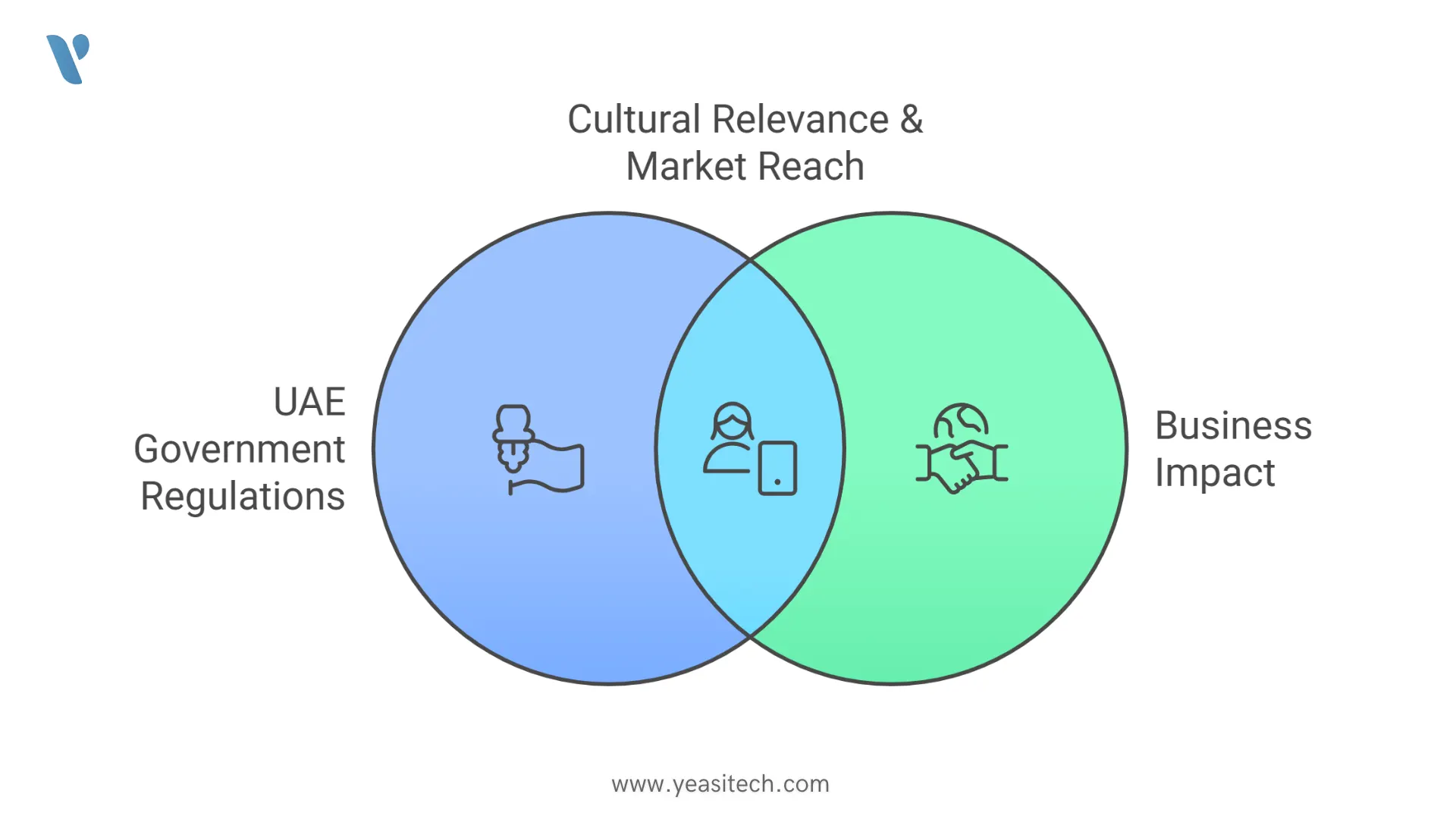
Yes, Arabic is the official language according to UAE government regulations. Yes, government services require it. But the real reason is business impact. Arabic isn’t just about language compliance. It’s about showing respect for local culture and reaching the entire market.
Around 11.5 million people call the UAE home. Emirati citizens speak Arabic. Long-term Arab residents prefer Arabic. Many expats who’ve lived here for years feel more comfortable in Arabic. When you skip Arabic support, you’re telling a huge portion of your potential users they don’t matter.
The UAE government made Arabic education mandatory in all schools in 2017. This isn’t accidental. The country wants to preserve its cultural identity while embracing global business. Your app needs to balance the same thing.
The Business Case Nobody Talks About
Apps with proper Arabic support see 40% to 60% higher user engagement in UAE markets. Not slightly higher. Dramatically higher. Users spend more time in the app. They complete more transactions. They recommend it to friends.
Why? Because people think, decide, and shop in their native language. Even if they speak perfect English, seeing content in Arabic creates trust. It feels local. It feels like the app was built for them, not just translated.
Government contracts and partnerships often require Arabic support. Major corporations in the UAE prefer vendors who show commitment to local culture. Retail apps with integrated Arabic and English experiences see 40% higher customer lifetime value in Dubai markets.
Here’s the part that really stings: adding Arabic after launch costs 3 to 5 times more than building it in from the start. You’re not just paying for translation. You’re paying to redesign layouts, restructure databases, fix bugs, and update marketing materials. Then you relaunch and try to win back users who already uninstalled your app.
Smart founders build Arabic app development uae capabilities into their plans from day one. They save money and avoid losing early momentum.
What Arabic Support Actually Means?
Most people think adding Arabic means hiring a translator. Wrong. Arabic support is a complete design challenge.
Arabic reads right to left. English reads left to right. This isn’t a small detail. It affects your entire user interface. Your navigation menus need to flip. Your reading order reverses. Text alignment changes. Icons that made sense on the left now sit on the right. Forms that flowed naturally suddenly feel awkward.
This is called RTL (right-to-left) layout support. Professional developers build flexible layouts that work for both directions without breaking. Amateur developers hardcode everything and spend weeks fixing issues later.
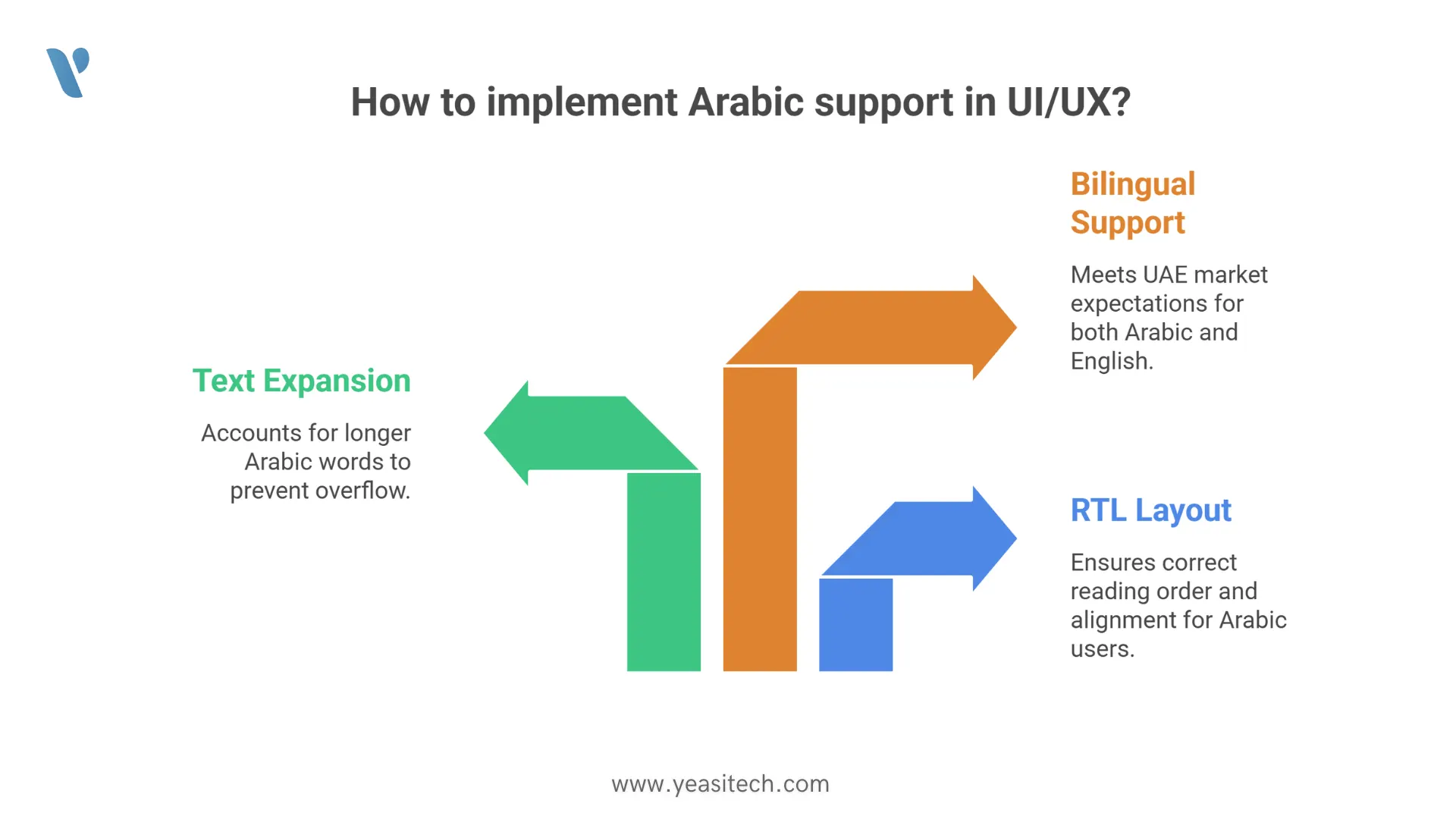
Then there’s the text itself. Arabic words are longer than English words. A button that says “Submit” becomes “إرسال” which takes more space. Your carefully designed UI suddenly has text overflowing everywhere. Professional designers account for text expansion of 20% to 30% in their mockups.
The UAE market expects bilingual support with Arabic and English, along with RTL layout for Arabic users. Both languages need to work perfectly. Users switch between them constantly.
Technical Implementation Requirements
1. User Interface Needs
Complete RTL mirror support so everything flows naturally in Arabic
Text expansion handling ensures nothing breaks when words get longer
Font selection matters because not all fonts support Arabic characters properly
Date and number formatting follows local conventions like Hijri calendar support
2. Content Strategy Requires
Professional translation, not Google Translate
Context matters – a word that works in one screen might be wrong in another
Cultural adaptation ensures your messaging resonates with local users
Voice and tone maintain your brand while respecting cultural norms
3. Technical Infrastructure Needs
Proper Unicode support for Arabic characters
Database configuration stores and retrieves Arabic text correctly
Search functionality works with Arabic input and finds relevant results
Sorting and filtering respect Arabic alphabetical order
Getting this right requires experienced developers who’ve done it before. Trying to figure it out yourself wastes months.
UAE Compliance Requirements You Cannot Ignore
Now let’s talk about compliance. This is where things get serious, and where most startups underestimate the complexity.
The UAE’s Personal Data Protection Law (Federal Decree-Law No. 45 of 2021) provides a comprehensive framework ensuring confidentiality and protecting individual privacy. This law applies to any app collecting user data in the UAE.
What does that mean practically? If you’re collecting names, phone numbers, email addresses, location data, or payment information, you need explicit user consent. Not the sneaky pre-checked boxes you see on shady websites. Real, informed consent with clear explanations of what you’re collecting and why.
What PDPL Compliance Actually Requires?
1. Data Collection and Consent:
Tell users exactly what data you’re collecting in clear Arabic and English
Explain why you need it and how you’ll use it
Get explicit consent before collecting anything
Allow users to refuse without losing basic functionality
Make it easy for users to withdraw consent later
2. Data Storage and Security
Encryption for data in transit and at rest
Access controls limit who can view sensitive information
Regular security audits identify vulnerabilities
Backup systems protect against data loss
Proper authentication and authorization systems
3. User Rights Management
Users can request to see their data
They can ask you to correct inaccurate information
They can demand that you delete their data completely
You need systems that handle these requests within legal timeframes
4. Breach Notification
Data Controllers must immediately notify the UAE Data Office if they experience a data breach
Affected users must be notified if the breach impacts privacy or security
You need monitoring systems that detect breaches quickly
You need procedures for reporting to authorities
The penalties for non-compliance aren’t small. The PDPL allows fines up to AED 5 million (approximately USD 1.36 million). That’s not including reputation damage when users find out you’ve mishandled their data.
The Special Requirements Nobody Warns You About
Beyond the federal law, UAE app development has local quirks you won’t find in textbooks.
Payment Integration: You can’t just slap Stripe on your app and call it done. Apps need integration with regional payment gateways like UAE PASS, PayTabs, and Telr. These platforms understand local banking systems, work with UAE credit cards, and handle Arabic interfaces properly.
Identity Verification: Many apps need integration with UAE PASS, the country’s digital identity system. Government services require it. Financial apps need it. Healthcare apps use it.
Cultural Considerations: Your app’s content needs a cultural sensitivity review. Images, language, and messaging that work globally might offend local sensibilities. The UAE has specific laws about content that’s considered inappropriate.
App Store Requirements: Both Apple and Google have specific requirements for apps serving the UAE market. Your app store listing needs Arabic descriptions. Screenshots should show Arabic interfaces. Age ratings must account for local content standards.
Real Costs: Bilingual App Development in the UAE
Let me be straight about money. Arabic app development uae isn’t free. But knowing the costs upfront helps you budget smartly.
Comprehensive Cost Breakdown
Cost Category
Basic Implementation
Professional Solution
Arabic UI/UX Design
AED 5,000-8,000
AED 10,000-18,000
RTL Development
AED 8,000-15,000
AED 18,000-30,000
Professional Translation
AED 3,000-6,000
AED 8,000-15,000
PDPL Compliance Setup
AED 7,000-15,000
AED 20,000-40,000
Legal Review & Documentation
AED 5,000-10,000
AED 12,000-20,000
Security Infrastructure
AED 6,000-12,000
AED 15,000-25,000
Payment Gateway Integration
AED 5,000-10,000
AED 12,000-18,000
Total Initial Investment
AED 39,000-76,000
AED 95,000-166,000
Ongoing Compliance (monthly)
AED 1,000-2,000
AED 3,000-5,000
How Bilingual Impacts Base Development Costs?
App Complexity
Base Cost (English Only)
Arabic Premium
Total Bilingual Cost
Simple App
AED 50,000-100,000
+20% (AED 10,000-20,000)
AED 60,000-120,000
Medium Complexity
AED 150,000-300,000
+20% (AED 30,000-60,000)
AED 180,000-360,000
Complex/Enterprise
AED 400,000-800,000
+20% (AED 80,000-160,000)
AED 480,000-960,000
Adding Arabic RTL support to an existing app costs 40-60% more than building it from the start. AAED 200,000 app becomes AED 280,000-320,000 when you retrofit Arabic support later.
Basic implementation gets you legal compliance and functional Arabic support. It works, but doesn’t impress. Professional solutions deliver polished experiences that compete with the best apps in the market. Natural Arabic translation. Smooth RTL transitions. Security that exceeds minimum requirements.
Most startups should aim somewhere in the middle. Get compliance right from day one. Polish the Arabic experience as you grow. Upgrade security as you handle more sensitive data. The key is building the foundation correctly
Proven Success: Real Case Studies
Let me show you what proper implementation looks like with real examples.
1. Places UAE: 1,000% Increase in Arabic Search Usage
A dining discovery app cataloging 3.5 million food and drink options from 10,000+ Dubai restaurants used Amazon Bedrock with Claude 3.5 Sonnet for Arabic natural language processing. After launching Arabic dialect-aware search in October 2024:
Arabic search usage increased 1,000%
Daily searches rose 267%
Total searches surpassed 100,000
Search speeds improved 50% over previous attempts
This demonstrates the ROI of investing in Arabic-native search rather than translated interfaces. Users don’t just accept Arabic support – they actively prefer it when done right.
2. Monterail: Bilingual Fintech MVP in Under 12 Weeks
A UAE real estate micro-investment app built with Flutter and Node.js delivered a bilingual MVP in under 12 weeks with a 12-person team. Key technical insights:
RTL design impacted text, progress bars, and icon choices
Required parallel design systems from Day 1
Arabic translation proved non-trivial – “first” and “second” differ by gender in Arabic
Needed neutral-form workarounds
Flutter handled most RTL edge cases well
3. Noon: Arabic-First E-Commerce at Scale
Backed by $1 billion from Saudi PIF, Noon was built for MENA from Day 0 rather than adapted from a Western platform. Features include:
Dynamic Arabic text expansion algorithms that auto-adjust product layouts
Culturally intelligent recommendation engines for Arabic shopping patterns
Revenue reached $169 million in 2024
Serves 4 million daily active users across 55,000+ merchants
4. Careem: $3.1 Billion Acquisition Built on Arabic-First Approach
Dubai-founded Careem’s Arabic-first approach and city-level cultural customization helped it reach 50 million customers across 10 countries before Uber’s $3.1 billion acquisition in 2019. Critical localization decisions:
Built its own location database (Google Maps was inaccurate in Middle East)
Supported cash-on-delivery from Day 1 – essential for MENA markets
Different pricing and protocols for Dubai vs. Riyadh
Most development teams don’t have deep experience with arabic app development uae. Offshore teams in Asia or Eastern Europe build great apps, but they’ve never handled RTL layouts or PDPL compliance. Local UAE agencies charge premium rates and sometimes lack technical depth. Look for partners who can show you:
Actual UAE Projects: Not generic international work. Ask to see live apps in the UAE app stores. Test them yourself. See if the Arabic feels natural or awkward.
Compliance Knowledge: They should explain PDPL requirements without googling. They should know the latest regulatory updates. They should have established processes for compliance implementation.
Cultural Understanding: They should ask questions about your target users. They should suggest cultural considerations you haven’t thought about.
Technical Capabilities: Modern frameworks that support internationalization. Security expertise. Understanding of mobile platform differences.
The right partner saves you money by avoiding expensive mistakes. They save you time by implementing solutions correctly the first time. They save you stress by handling compliance complexities you don’t understand.
Why YeasiTech for Arabic App Development UAE?
YeasiTech specializes in arabic app development uae with proven experience launching apps in the Gulf region. Our team handles the technical complexity of RTL layouts, the legal requirements of PDPL compliance, and the cultural nuances that make apps resonate with local users.
Whether you’re starting fresh or fixing an existing app, we’ll help you avoid expensive mistakes and build something users love.
1. Why is Arabic language support important for app development in the UAE?
Arabic language support helps UAE startups reach a larger user base and build trust with local customers. Many users prefer apps in Arabic, especially for payments, food delivery, government services, and daily use applications. Apps without Arabic often see 40-60% lower engagement and retention rates
2. Is Arabic language support mandatory for UAE startup apps?
Arabic is legally required for consumer-facing apps under Article 26 of UAE Consumer Protection Law. All contracts, advertising, and consumer data must be in Arabic. Other languages can be used alongside Arabic. Violations carry fines of AED 3,000-200,000 plus potential imprisonment up to 6 months
3. What does local compliance mean for app development in the UAE?
Local compliance includes following UAE data protection rules under PDPL (Federal Decree-Law No. 45 of 2021), payment regulations, and content guidelines. Startups must ensure proper data storage practices, clear privacy policies, user consent mechanisms, and compliance with UAE Data Office requirements to avoid penalties up to AED 5 million.
4. When should UAE startups add Arabic language support during app development?
Arabic support should be planned from the beginning of development. Adding it later requires redesigning layouts, adjusting right-to-left interfaces, and rewriting content structures, which increases costs by 40-60%. Building bilingual architecture from day one saves significant time and money
5. How much does it cost to add Arabic language support to an existing app in the UAE?
Adding Arabic to an existing app costs AED 30,000-80,000 for simple apps and AED 80,000-200,000 for complex apps. This includes RTL layout redesign, professional Arabic translation, cultural adaptation, and extensive testing. Planning for bilingual support early reduces these costs by 40-60%.
6. How does Arabic localization improve app growth for UAE startups?
Arabic localization improves app downloads by 30-50%, user retention by 40-60%, and customer trust significantly. Users are more likely to complete registrations and payments when the app feels familiar and easy to understand in their preferred language, which directly impacts revenue growth.
7. What is PDPL compliance and why does it matter for UAE apps?
PDPL (Personal Data Protection Law) is UAE’s Federal Decree-Law No. 45 of 2021 that protects user privacy. Apps must obtain explicit user consent for data collection, implement proper security measures, allow users to access and delete their data, and report breaches within 72 hours. Non-compliance can result in fines up to AED5 million.
8. How long does PDPL compliance implementation take for UAE apps?
PDPL compliance implementation takes 4-8 weeks for basic apps. This includes consent mechanisms, privacy policy updates, data subject rights portal, encryption setup, and breach notification procedures. Healthcare apps require 8-12 weeks, and fintech apps need 10-16 weeks due to additional sector-specific regulations like DHA or CBUAE requirements.