

UAE founders face distinct challenges when hiring offshore: PDPL data compliance, Arabic-language UI requirements, and IST-to-GST time-zone overlap. This guide covers what generic offshore advice skips — the legal, cultural, and operational factors specific to Dubai and Abu Dhabi.
Most offshore development guides were written for a generic global audience and then quietly recycled for every market. If you are a founder based in Dubai or Abu Dhabi, that means the advice you find online skips the questions that actually matter to you: how does India’s IST overlap with Gulf Standard Time, what does PDPL mean for your data handling obligations, and how do you structure a contract with an offshore team when you are operating under UAE commercial law?
This guide addresses those questions directly. It is written for UAE-based founders who are evaluating offshore software development as a way to build or scale a product, and who need practical guidance rather than a repurposed list of generic outsourcing tips.
Yeasitech has worked with clients across the Gulf region since 2018. What follows is based on what we have learned navigating real engagements with UAE founders, not a theoretical framework built from someone else’s playbook.
Why UAE founders are choosing offshore development right now
Hiring senior engineering talent locally in Dubai is expensive and slow. The competition for skilled developers in the UAE is intense, driven by a dense concentration of funded startups, regional enterprise digitisation programs, and global tech firms expanding Gulf operations.
Offshore development with an India-based team offers savings ranging between 40% and 70% compared to onshore hiring. For a founder building an MVP or scaling a product on Series A capital, that cost delta is meaningful. It is not about finding the cheapest option. It is about accessing senior engineering capacity that would otherwise consume most of your runway before you reach product-market fit.
The shift in how UAE founders think about offshore has also matured. The concern used to be quality and communication. Now the more sophisticated founders are asking about compliance, IP ownership, and how to structure the engagement to maintain velocity without losing control. Those are the right questions, and they deserve direct answers.
The time-zone advantage: how IST overlaps with GST in practice
One of the practical reasons UAE founders find India-based teams easier to work with than European or US teams is the time-zone relationship.
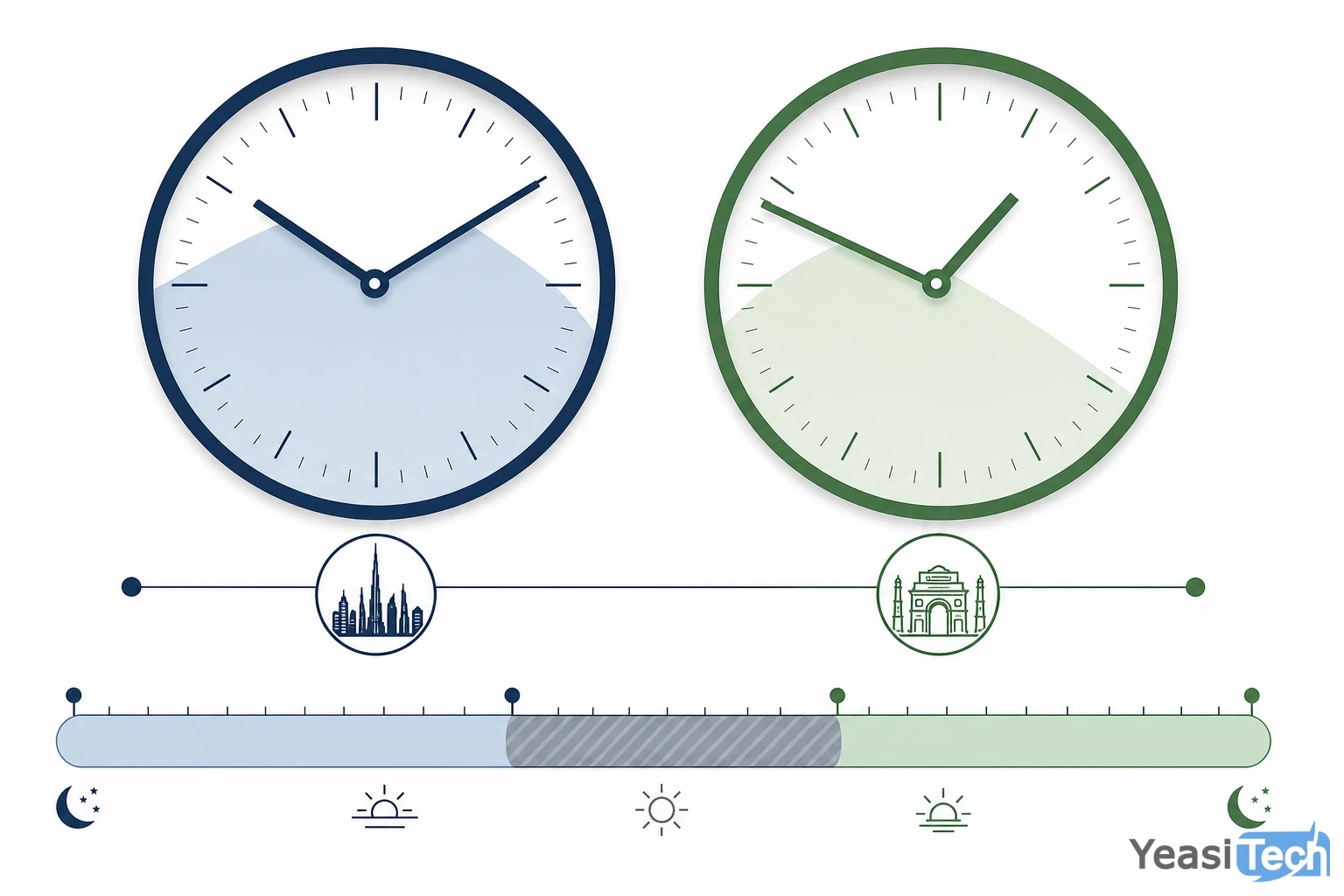
IST runs 1.5 hours ahead of GST, creating a natural 4-6 hour daily overlap that enables same-day standups, feedback loops, and sprint demos without unsociable hours for either side.
India Standard Time (IST) is 1.5 hours ahead of Gulf Standard Time (GST). When your team in Dubai starts work at 9:00 AM, it is already 10:30 AM in Kolkata or Bangalore. This creates a natural working overlap of four to six hours during a standard business day, without either side working unusual hours.
In practice, this means:
- Morning standups work without calendar gymnastics. A 9:30 AM Dubai call is 11:00 AM in India. Both sides are in core working hours.
- Same-day feedback loops are real. If you review a feature at 10:00 AM GST, the engineering team can action it during their afternoon and have an update ready before your end of day.
- Sprint demos and milestone reviews are friction-free. Weekly demos, which are central to an agile engagement, can happen during shared business hours rather than requiring after-hours availability from either party.
Compare this to working with a team in Eastern Europe, where a 9:00 AM Dubai call hits at 7:00 or 8:00 AM in Warsaw, or a US-based team where real-time collaboration is structurally impossible during normal hours. The IST-GST overlap is a genuine operational advantage, not a marketing line.
PDPL, DIFC, and what compliance actually means for your offshore engagement
UAE founders operating under the Personal Data Protection Law (PDPL) or within DIFC’s data protection framework have specific obligations when personal data leaves the country or is processed by a third party. Generic offshore guides do not address this. Here is what you need to understand before you sign a contract.
Data residency vs. data processing. PDPL distinguishes between where data is stored and where it is processed. An offshore development team building your platform does not necessarily need to access production data containing personal information. For most development engagements, synthetic or anonymised datasets are sufficient. Your obligation is to ensure your contract explicitly restricts the offshore team from accessing, storing, or processing live personal data unless a formal data processing agreement is in place.
DIFC considerations. If your entity is registered in DIFC, the DIFC Data Protection Law 2020 applies independently of federal PDPL. DIFC has its own adequacy framework, and India is not currently on the DIFC adequacy list. This means a data transfer mechanism (such as standard contractual clauses adapted to DIFC requirements) should be included in your contract if any personal data will be shared during development.
What a compliant offshore contract should include:
- Data Processing Agreement (DPA) that specifies permitted use, storage location, and deletion obligations
- NDA with explicit IP assignment clauses, executed before any work begins
- Clarity on who owns code, models, and training data upon project completion
- Audit rights allowing you to verify compliance practices
For a deeper look at how PDPL-compliant software development applies to your product build, Yeasitech has published a dedicated guide covering the requirements UAE founders most frequently misunderstand.
Arabic-language and RTL UI: where most offshore teams fall short
If your product serves Gulf users, Arabic-language support is not an afterthought. It is a core product requirement that affects architecture decisions, UI component choices, and QA scope. Most offshore teams can add a translation layer. Far fewer have genuine experience building right-to-left (RTL) interfaces from the ground up.
The difference matters more than founders expect. RTL layout is not simply mirroring a left-to-right UI. Navigation hierarchies, input field alignment, date and number formatting, icon directionality, and bidirectional text handling (mixing Arabic and English in a single view) all require deliberate engineering decisions. Teams that treat RTL as a CSS afterthought create products that feel broken to Arabic-speaking users, even when the translation is technically accurate.
What to ask an offshore team before you engage:
- Have you built RTL interfaces before, and can you share examples?
- What framework do you use for bidirectional text rendering, and how do you handle mixed-language strings?
- How do you handle Arabic numeral formatting versus Eastern Arabic numerals in financial contexts?
- Who on your team reviews Arabic UI from a native user perspective?
Yeasitech’s dedicated guide on Arabic app development and localisation in the UAE covers the technical requirements in detail, including framework selection and QA considerations specific to Gulf-market products.
How to run a pilot engagement before committing
The single most effective way to de-risk an offshore engagement is to run a structured pilot before signing a full-project contract. This is especially important for UAE founders who cannot fly to Kolkata or Bangalore for an in-person vetting session.
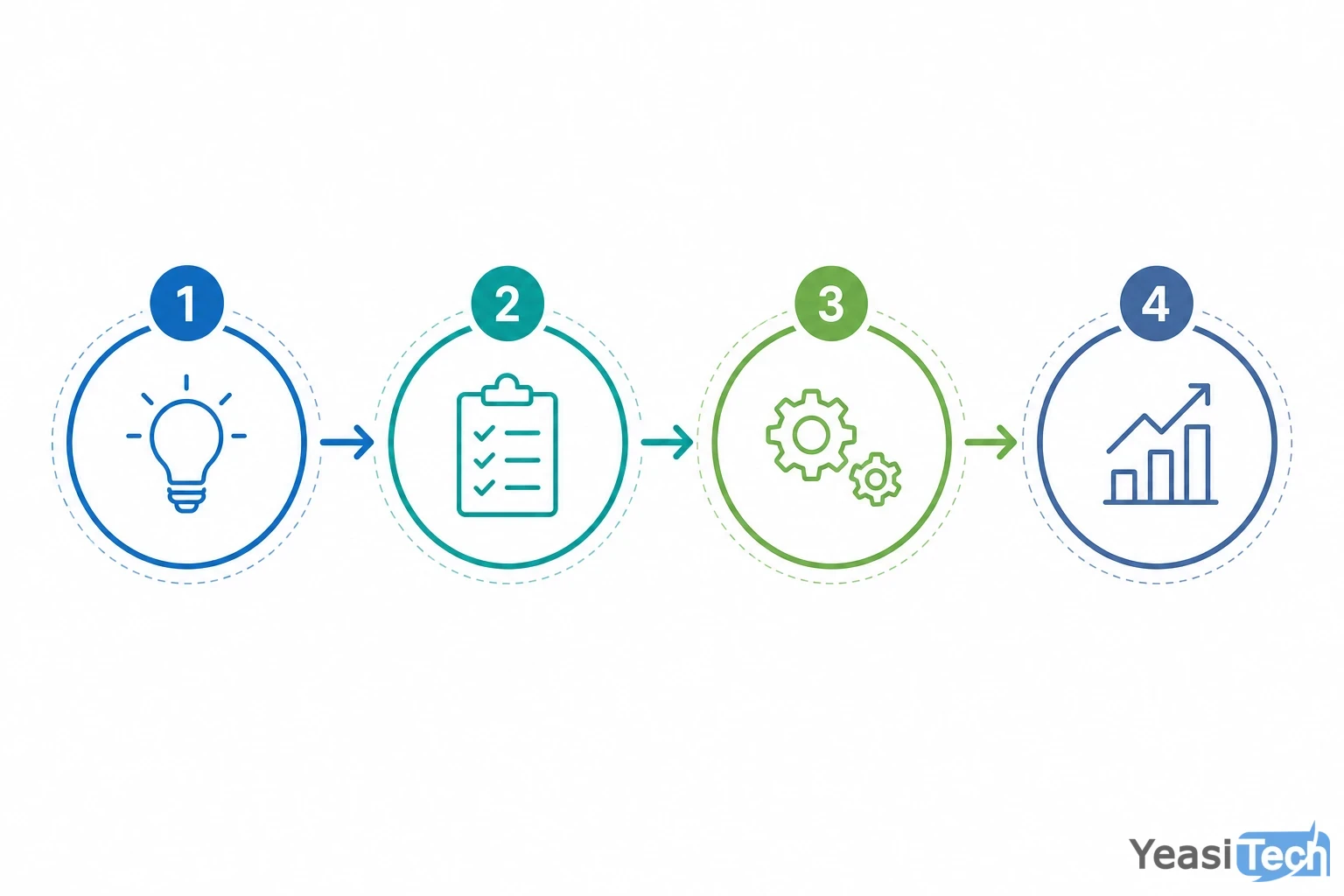
A four-stage pilot framework that UAE founders can use to evaluate an offshore team before committing to a full engagement contract.
A well-structured pilot runs four to six weeks and covers a bounded, meaningful piece of work. Not a test task. Not a free sample. A paid sprint that produces real output and reveals how the team actually operates under working conditions.
The four stages of a pilot engagement:
- Scoping call. Define the pilot deliverable precisely. It should be complex enough to test architecture thinking, not just execution. A well-scoped pilot scope also signals whether the team asks the right clarifying questions before they start building.
- Paid discovery sprint. The team produces a technical specification, wireframes, or architecture diagram for the pilot deliverable. This is the fastest way to assess thinking quality before a line of code is written.
- Milestone review. At the midpoint of the build sprint, review working output. How close is it to the spec? How does the team handle feedback? Do they push back constructively or just agree and disappear?
- Full engagement decision. With real output and real communication patterns as evidence, you now have a grounded basis for deciding whether to proceed. Not a sales pitch. Not references from clients you cannot verify.
McKinsey research shows that structured, multidisciplinary team setups with automated delivery pipelines improved delivery predictability from 60 to 95 percent within three months. A pilot is how you confirm whether your prospective partner operates this way before you are committed.
For UAE founders evaluating how to hire skilled remote developers from India, Yeasitech’s guide covers the evaluation criteria and red flags to watch for during the process.
What to look for in an offshore development partner if you are based in the UAE
Not every offshore agency is equipped to serve UAE founders well. Beyond the standard checks (portfolio, references, tech stack), there are UAE-specific criteria that narrow the field quickly.
Prior UAE or Gulf client experience. This is not about geography as a selling point. It is about whether the team has already encountered PDPL discussions, Arabic UI requirements, and DIFC contract clauses in real engagements. Teams that have not will encounter these for the first time on your project.
Contractual transparency before you pay anything. Fixed-price engagements with detailed upfront scoping protect UAE founders from the scope creep and invoice surprises that plague time-and-materials contracts. Ask to see a sample contract and scope document before you agree to anything.
Dedicated team structure, not a resource pool. The dedicated development team model means you work with the same engineers across your engagement, not whoever is available that sprint. For UAE products requiring continuity of context, particularly those with Arabic-language requirements or compliance constraints, a rotating resource model introduces unnecessary risk.
Senior-led, not junior-heavy. Many offshore agencies quote competitive rates by staffing projects with junior engineers supervised by one senior. Ask directly: who leads the technical architecture on your project, and what is their experience level? The answer tells you everything about the quality floor you are buying.
If you are ready to discuss your specific requirements, Yeasitech offers a free project estimate within 24 hours of inquiry, with no obligation to proceed.
Frequently asked questions
Is offshore software development legal for UAE companies?
Yes, UAE companies can legally engage offshore development teams. The key requirements are a properly drafted contract with IP assignment clauses, an NDA executed before work begins, and a Data Processing Agreement if any personal data will be shared with the offshore team under PDPL or DIFC frameworks.
How does PDPL affect working with an Indian development team?
PDPL restricts cross-border transfer of personal data without adequate protections in place. Most development work can proceed using anonymised or synthetic data, avoiding the issue entirely. Where live data must be shared, a formal data processing agreement and contractual safeguards are required before any transfer occurs.
What time zone overlap exists between Dubai and India?
India Standard Time (IST) runs 1.5 hours ahead of Gulf Standard Time (GST). This creates four to six hours of natural overlap during a standard business day, making same-day standups, feedback loops, and weekly sprint demos possible without either side working outside normal hours.
Can offshore teams build Arabic RTL apps for Gulf users?
Some offshore teams can, but genuine RTL experience is less common than agencies claim. Before engaging, ask for live examples of Arabic UI they have built, how they handle bidirectional text rendering, and whether a native Arabic speaker reviews the UI during QA. Teams without prior RTL experience will learn on your project.
How do I structure a contract with an offshore developer from UAE?
Use a fixed-price contract with detailed scope upfront, rather than time-and-materials. Include full IP assignment on completion, an NDA covering all project materials, a Data Processing Agreement if personal data is involved, and audit rights. Have the contract reviewed under UAE commercial law before signing.
What does a pilot engagement with an offshore team look like?
A structured pilot runs four to six weeks across four stages: a scoping call, a paid discovery sprint producing a technical specification, a midpoint milestone review of working output, and a final decision to proceed or not. The pilot should be paid and cover a meaningful deliverable, not a free test task.