PDPL Compliant Software Development in UAE: What Your Product Actually Needs
29 April, 2026Last Updated
18 minutesRead
462Views
If you are building or running software in the UAE right now, there is a question you need to answer honestly, Is your product genuinely PDPL compliant? Not “kind of compliant.” Not “we have a privacy policy” compliant. Actually, technically, verifiably compliant with the UAE’s Personal Data Protection Law.
PDPL compliant software development in the UAE is not optional anymore. Federal Decree-Law No. 45 of 2021 came into effect on January 2, 2022, and the guidance on what it specifically demands from your codebase has been scattered, technical, and genuinely difficult to translate into a sprint backlog.
So most teams did what teams do under uncertainty. They added a cookie banner. They wrote a privacy policy. They told themselves they would deal with the rest later.
Later is here.
The PDPL applies to any business that processes personal data of UAE residents. It does not matter whether you are a startup or a multinational. If UAE residents use your product and you store their data, the law covers you. Fines range from AED 50,000 to AED 5 million per violation depending on severity, and regulators have made software products a clear enforcement priority.
The good news is that building PDPL compliant software in the UAE is entirely achievable. It requires specific features, built the right way, and this guide tells you exactly what they are. Written for product managers and business owners, not lawyers. By the end, you will know what your software needs, why each requirement exists, and what it takes to get there.
Table of Contents
What PDPL Compliant Software Development in the UAE Actually Means
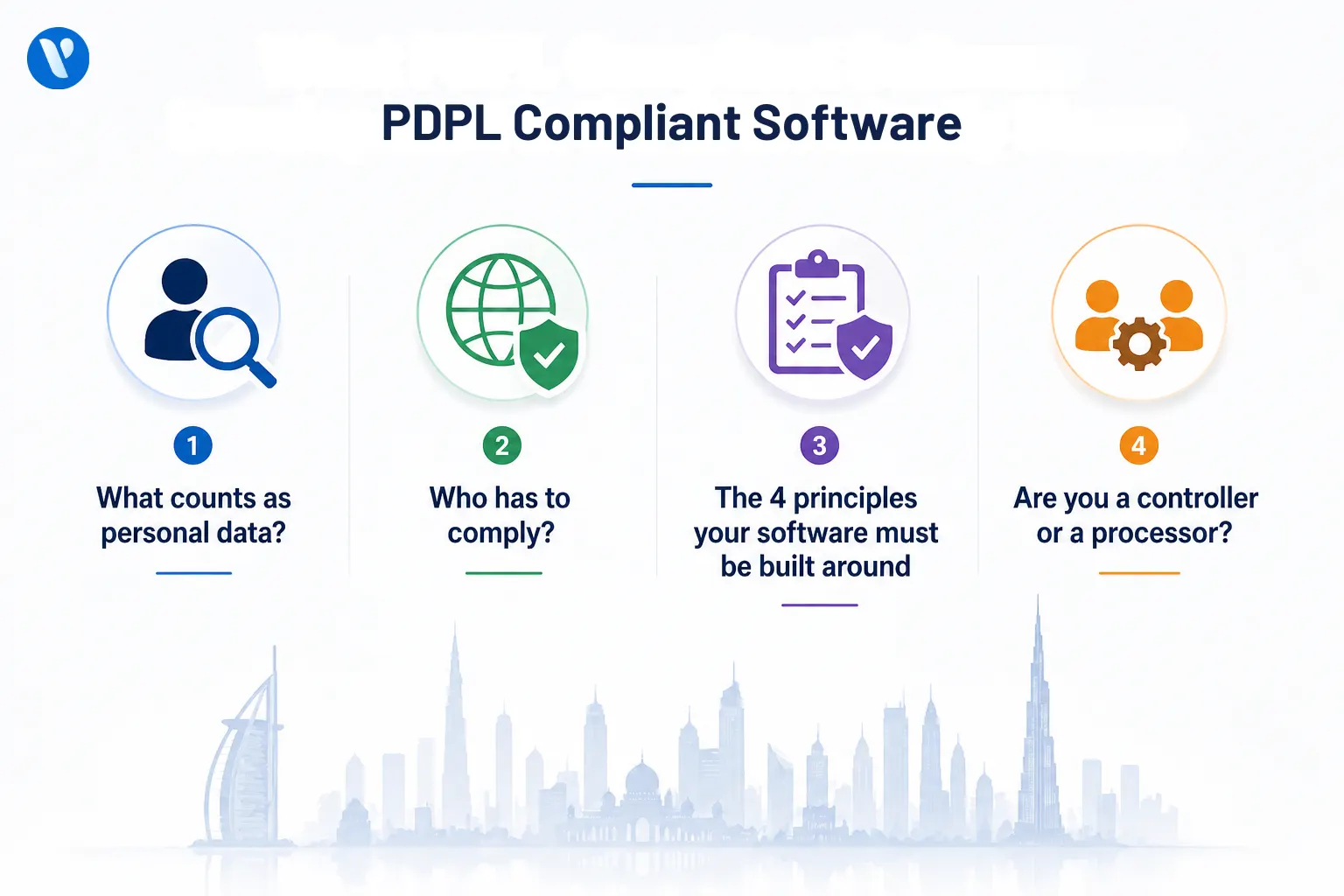
Before getting into the features your compliance software must include, it helps to understand the four ideas that shape almost every decision you will make. Think of these as the mental model behind all the rules.
What counts as personal data?
Broader than you probably think. The law covers any information that can identify a person, directly or indirectly. Names and email addresses, obviously. But also IP addresses, device IDs, location data, browsing behaviour, financial records, and combinations of data points that together could identify someone even if each one seems harmless on its own.
Certain categories get stricter treatment: biometric data, financial information, religious and political beliefs, criminal records, genetic data, and anything relating to children under 18. One important nuance: clinical health data held by healthcare providers is covered under its own sector-specific legislation, not the PDPL directly. However, if your software collects health-related personal data outside a clinical context (a wellness app, for example), PDPL still applies.
Who has to comply?
If UAE residents use your product, you do. The law follows the data subject, not the data processor. Your company could be registered in Singapore with servers in Germany and if you have UAE users, it still applies. This extraterritorial scope catches a lot of international SaaS teams off guard.
The four principles your software must be built around:
Consent: Get permission before you collect data, make it specific and informed, and let users withdraw it whenever they want.
Purpose limitation: If you collected someone’s email for order confirmations, you cannot start using it for retargeting campaigns without asking again.
Data minimisation: Only collect what you genuinely need. Storing data because it might be useful someday is not a lawful reason.
Accuracy: Give users a way to correct their information, and make reasonable efforts to keep it current.
Are you a controller or a processor?
This distinction shapes your compliance obligations significantly. A controller decides why and how data is processed. A processor handles data on someone else’s behalf. If you build a product that collects user data directly, you are a controller. If you use third-party APIs like analytics tools, payment gateways, or CRM platforms, those vendors become your processors, and you need written data processing agreements with all of them.
Controllers carry the heavier burden under the law. If you have never asked your API vendors for a Data Processing Agreement, that is a gap in your UAE software compliance that needs fixing soon.
From the YeasiTech team One of the first things we do with any new PDPL software development project is map out the client’s controller and processor relationships. It sounds straightforward, but it regularly surfaces third-party integrations that nobody on the product team knew were receiving personal data. Fixing those early costs a fraction of what it costs after a complaint or an audit.
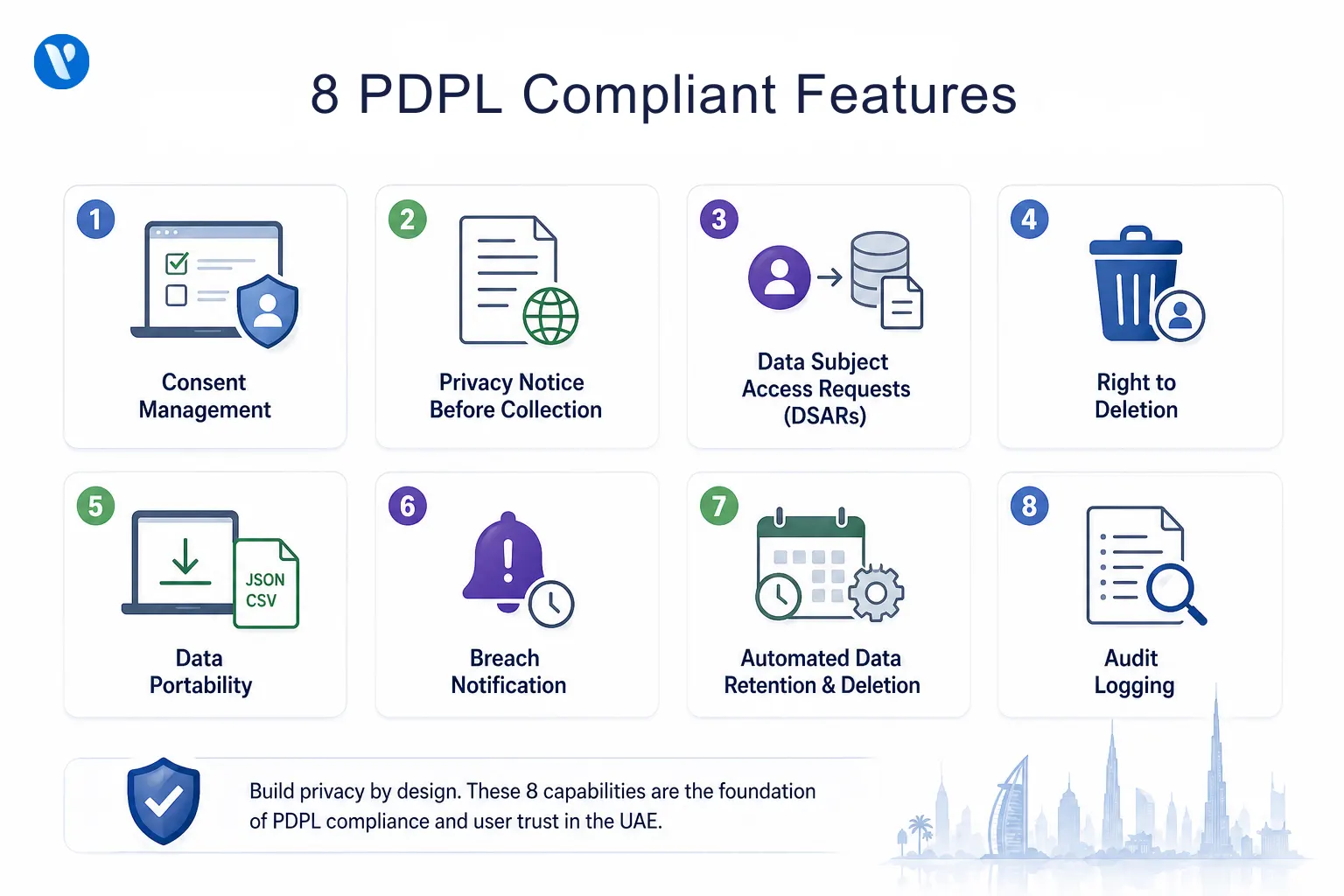
The 8 Features Every PDPL Compliant Software Product Needs
Here is the part most compliance guides skip: what PDPL compliant software development in UAE actually requires your product to do. These eight features are not optional extras or nice-to-haves for your next sprint. They are the minimum. If your product is missing any of them, you have a compliance gap that needs to be prioritised.
1. Consent Management: Why a Cookie Banner is Not Enough
A cookie banner is a start. It is not PDPL compliant software. Your product needs a proper consent management layer where users can grant or withhold consent for specific data purposes separately – agree to essential service processing, decline marketing analytics. That level of granularity is required.
Every consent decision must be stored: who gave it, when, which version of your privacy policy they were shown, and whether they later withdrew it. Your application logic must check consent status before processing data in any given category. Not just once at signup. Every time.
2. Show Users Your Privacy Notice Before You Collect Anything
Not in the footer. Not buried in your terms and conditions. Before a user submits their first email address, they need to see, in plain language, what data you are collecting, why, how long you keep it, and who you share it with. The law also requires this notice to be available in Arabic for UAE-resident users, making bilingual notice design a standard part of UAE PDPL software development.
Keep the language simple. The privacy notices that create problems are the ones written by lawyers for lawyers.
3. Data Subject Access Requests (DSARs)
Any user can ask: what data do you hold on me? Under the law, you have 30 days to give them a complete, readable answer. This sounds manageable until you realise the data is probably spread across five database tables, two third-party integrations, an email platform, and a support tool.
Building a DSAR tool into your compliant software that can aggregate all of that by user identity, package it cleanly, and deliver it on time is a meaningful engineering task. It is significantly easier to design this capability into your data architecture early than to retrofit it later.
4. Right to Deletion
Users can ask you to delete everything. And you have to do it completely: primary database, backups within a reasonable technical window, logs, third-party processors, all of it. This is one of the features where poor database design becomes expensive. If your schema was not built with user-scoped deletion in mind, retrofitting it can be a major refactoring project.
Building deletion from day one means designing your data model with user-scoped removal in mind, not treating it as an afterthought.
5. Data Portability
Users have the right to take their data with them. Your software must be able to generate a structured export of everything you hold about a specific user, in a format like JSON or CSV, on request. It needs to be complete, clearly organised by category, and easy to obtain without making the user jump through unnecessary steps.
6. Breach Notification
If a breach occurs that puts users at risk, Article 9 of the PDPL requires you to notify the UAE Data Office as soon as you become aware of it. The widely accepted interpretation, consistent with GDPR practice, is that notification should happen within 72 hours where feasible. If the risk to users is high, you notify them directly as well.
Note: the specific procedural timeline and requirements will be confirmed in executive regulations that are still pending as of 2025. Build your breach response process to the 72-hour standard now – it aligns with international practice and the Data Office’s stated expectations.
Your software needs monitoring that detects anomalous data access, an internal triage workflow for assessing severity, pre-approved notification templates, and a user communication process ready to activate. Build the playbook before you need it.
7. Automated Data Retention and Deletion
You cannot keep personal data indefinitely. The law requires you to define a retention period for each category of data and delete it automatically when that period expires. In practice, this means a scheduled deletion job that runs on a defined cycle, retention periods documented in both your privacy notice and your codebase, and a process for the edge cases where deletion interacts with legal hold requirements.
None of this is especially complex to build when it is planned into your software development from the start. It becomes expensive to retrofit.
8. Audit Logging
If a regulator ever investigates your data processing, or a user disputes how their data was used, your audit log is your primary evidence. It records every access, modification, export, and deletion of personal data, along with the identity of whoever or whatever performed the action, and when.
The log must be tamper-evident, retained for a defined period, and cover not just human users but also automated processes and third-party API calls that touch personal data. This is a non-negotiable part of demonstrable compliance for any UAE software product.
From the YeasiTech team: We have built all eight of these features as modular components across our UAE PDPL software development projects. If you are starting from scratch, we bake them in from sprint one. If you have an existing product with gaps, we can run a structured audit and scope the remediation accurately before any development begins.
From the YeasiTech team: We have built all eight of these features as modular components across our UAE PDPL software development projects. If you are starting from scratch, we bake them in from sprint one. If you have an existing product with gaps, we can run a structured audit and scope the remediation accurately before any development begins.
Data Residency Requirements for PDPL Compliant Software
A lot of businesses get this wrong because they assume the law is purely about how you handle data, not where you store it. Both matter. Data residency is a core consideration in any UAE PDPL software development project.
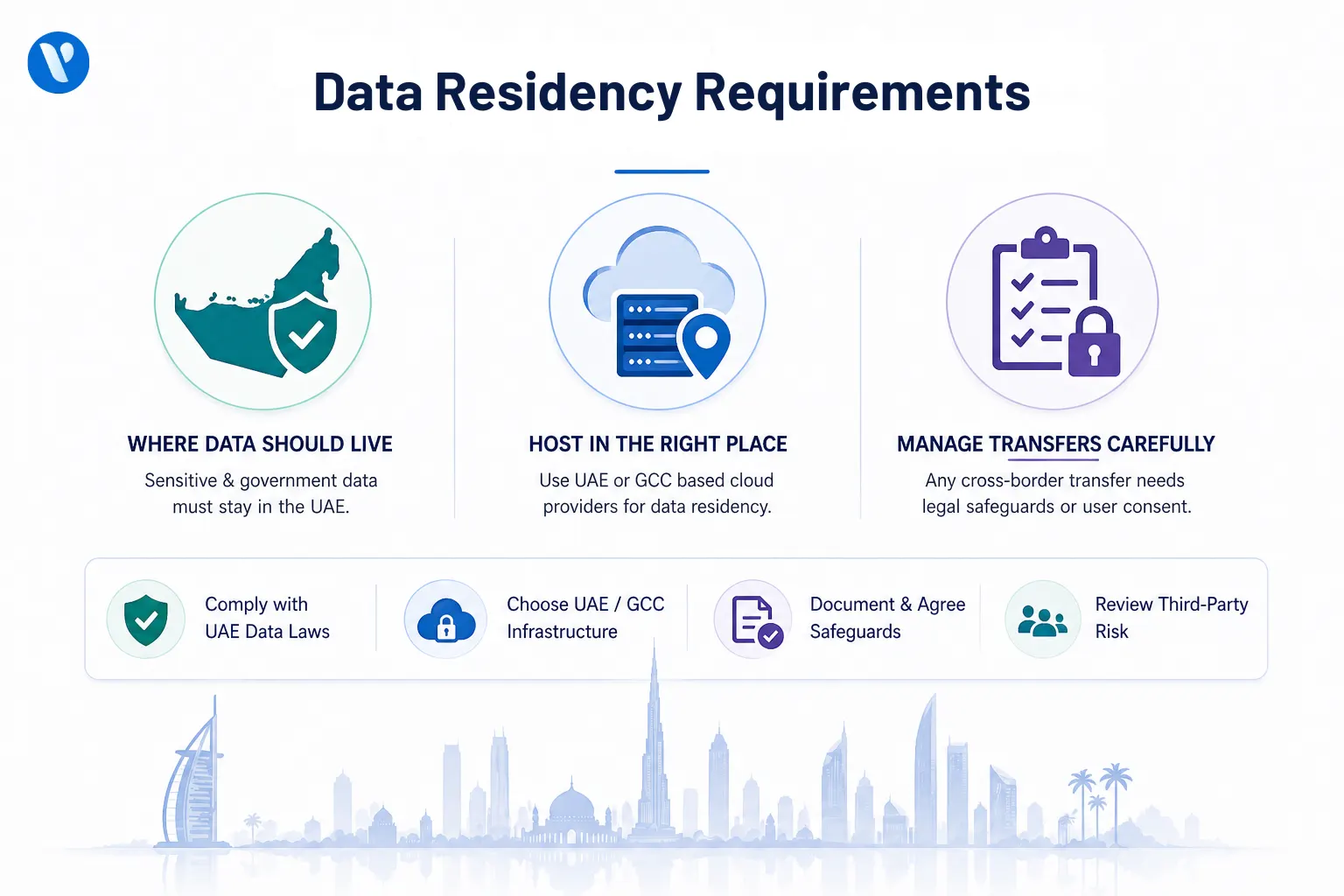
When Does Data Have to Stay in the UAE?
Sensitive personal data and data processed by government entities must remain within UAE borders. For most commercial software products, cross-border transfer is permitted, but only under specific conditions: the destination country must be on the UAE Data Office’s approved adequacy list, standard contractual clauses must be in place with whoever receives the data, or the user must have explicitly consented knowing their data is leaving the UAE.
For most teams, the cleanest solution is to host on UAE-resident or GCC-resident infrastructure from day one and remove the cross-border transfer question entirely.
Which Cloud Providers Work for UAE Data Residency Compliance?
Three options cover most use cases. AWS Middle East (Bahrain) is the most widely used for UAE PDPL software development. Microsoft Azure UAE North (Abu Dhabi) has strong uptake among UAE enterprise and government clients. For organisations needing absolute in-country sovereignty, G42 Cloud and du Cloud operate within UAE borders.
Whichever provider you choose, make sure your services agreement explicitly specifies UAE data residency. And watch CDN configurations carefully. It is easy to inadvertently cache personal data in edge locations outside the UAE through a globally distributed CDN, creating a compliance violation that nobody intended.
One Thing Teams Frequently Overlook
Third-party integrations create cross-border transfer exposure that is separate from your hosting choice. If your analytics platform, support desk, or email tool stores data on servers outside the UAE or an approved country, that transfer must be covered by contractual safeguards or user consent. Most standard SaaS vendor agreements do not include UAE data transfer clauses by default. Ask for them specifically. Get them in writing before you go live.
Technical Implementation Checklist for UAE PDPL Software
Here is what the law requires, broken down into concrete engineering tasks. Use this as a working reference with your development team when planning your compliance sprint backlog.
What you need
How to implement it
Tools that work well
Encryption at rest
AES-256 on all database volumes and backups
AWS RDS encryption, Azure TDE, pgcrypto
Encryption in transit
TLS 1.2 minimum on all connections, including internal services
Let’s Encrypt, AWS ACM, enforce HTTPS-only
Role-based access control
Least-privilege access; staff see only what their role requires
Auth0 RBAC, AWS IAM, custom permission tables
Pseudonymisation
Replace identifiers with tokens in analytics pipelines and logs
Tokenisation libraries with a separate key store
Test data anonymisation
Never use real personal data in development environments
Faker.js, Mimesis, custom anonymisation scripts
API security
Third-party APIs must not receive personal data beyond their scope
API gateway with field filtering, OAuth scopes, DPAs
Mobile consent handling
Mobile apps must honour consent settings, not bypass them
iOS ATT framework, Android Privacy Sandbox
Automated deletion jobs
Scheduled jobs that purge or anonymise data past retention period
Cron jobs, AWS Lambda, Temporal, Airflow
Pseudonymisation vs Anonymisation: A Distinction that Matters for Data Compliance
Pseudonymisation replaces identifying fields with tokens that can be reversed with a separate key. It is useful in production because it protects data while keeping it functional. But pseudonymised data is still personal data under the law, because re-identification is theoretically possible. It does not take your software outside the scope of UAE compliance requirements.
Anonymisation removes identifying information irreversibly. Truly anonymised data falls outside the law entirely. Use pseudonymisation in production. Use full anonymisation for analytics datasets and development environments.
Mobile Apps Need Their Own Compliance Plan
Both iOS and Android have platform-level privacy frameworks that your app must integrate correctly. You cannot access contacts, camera, location, or health data without explicit in-app permission tied to a stated purpose. That permission must flow through the same consent management system as your web product, not operate as a separate silo. Marketing push notifications are governed by both platform rules and this law. Data collected by your mobile app must be subject to the same retention and deletion schedules as everything else in your compliant software stack.
Five PDPL Compliance Failures We See Most Often in UAE Software Audits
Storing session tokens in browser localStorage with no expiry.
Logging full API request bodies that contain personal data.
Using a single database user for all application operations with no role separation.
Keeping deleted user records as soft deletes indefinitely with no purge schedule.
Sending personal data to analytics platforms without verifying that user consent covers the transfer.
All five are avoidable. All five are common. All five show up in compliance audits regularly.
Free Zone Considerations for PDPL Compliant Software
If your business or your clients operate within DIFC or ADGM, the federal PDPL is not the only framework that governs your UAE software compliance. Both free zones have independent data protection regimes, and the differences matter when you are scoping PDPL compliant software development.
Aspect
Federal PDPL
DIFC DP Law
ADGM DPER
Governing law
PDPL (No. 45 of 2021)
DIFC DP Law No. 5 of 2020
ADGM DPER 2021
Regulator
UAE Data Office
DIFC Commissioner of Data Protection
ADGM Office of Data Protection
Modelled on
International best practice
GDPR (closely aligned)
Similar to DIFC
Cross-border rules
Adequacy list or SCCs required
GDPR-style adequacy framework
Similar to DIFC
Breach window
72 hours to regulator
72 hours to the regulator
72 hours to Registrar
DPO required?
Not universally mandated
Yes, for high-volume sensitive data
Context-dependent
DIFC: The GDPR-aligned Framework
DIFC’s Data Protection Law is modelled closely on GDPR. If you have built a GDPR-compliant product before, much of that work translates. But DIFC entities face stricter accountability documentation requirements and a mandatory DPO appointment for organisations processing high volumes of sensitive data.
The part that catches teams out: DIFC law governs operations within DIFC, but if that same entity processes data of UAE residents outside DIFC, the federal law can apply concurrently. Two frameworks, one product to satisfy both. The practical answer is always to build to the strictest applicable standard and not try to draw artificial lines between jurisdictions.
ADGM: Same Principle, Different Regulator
ADGM’s Data Protection Regulations are broadly equivalent to DIFC’s framework. Consent management, data subject rights, breach notification, and transfer restrictions all apply in comparable forms. The main practical difference is the regulator: ADGM entities report to the ADGM Office of Data Protection rather than the DIFC Commissioner.
What to Do When Multiple Frameworks Apply to Your Product
Build once to the strictest standard. A product genuinely compliant with DIFC’s GDPR-aligned requirements will satisfy the federal law for mainland UAE users. Build your software to DIFC-level, and you have a single product that serves all three markets without architectural changes per client. That is a significantly better position than maintaining different compliance configurations for each audience.
Common Questions About PDPL Compliant Software Development in UAE
1. What is PDPL compliant software development in the UAE?
PDPL compliant software development in UAE means building applications that meet the requirements of Federal Decree-Law No. 45 of 2021. In practice, this means your software must include eight core features: consent management, privacy notice display, data subject access request handling, right to deletion, data portability, breach notification, automated retention enforcement, and audit logging. It also requires appropriate data residency, role-based access controls, encryption, and documented data processing agreements with all third-party vendors.
2. What is the penalty for PDPL non-compliance in UAE software?
Fines reach up to AED 5 million per violation. Because the law treats each violation independently, a product with multiple compliance gaps can face penalties that compound significantly. Violations involving sensitive personal data, or those that cause demonstrable harm to users, attract higher penalties within the scale. For many businesses, the reputational cost of a public enforcement action is a larger risk than the fine itself.
3. Does the PDPL apply to software companies not based in the UAE?
Yes, if UAE residents use the product. The law follows the data subject, not the company’s registered address or server location. A SaaS platform incorporated abroad with UAE customers must achieve PDPL compliant software development to the same standard as a Dubai-based company. This is the same extraterritorial logic as GDPR, and it catches many international businesses by surprise.
4. How long does PDPL compliant software development take in the UAE?
For a new build, integrating all eight compliance features from the start adds approximately two to four weeks to a typical product development timeline, depending on scope. For an existing product with gaps, the remediation timeline depends on the severity of the issues found in a proper audit. Products with poorly designed data schemas or no consent management at all can require six to twelve weeks of focused PDPL compliance development work.
5. Can I store UAE user data on servers outside the UAE?
Yes, under specific conditions. The destination country needs to be on the UAE Data Office’s adequacy list, or standard contractual clauses need to be in place, or you need explicit user consent for the transfer. For most UAE PDPL software development projects, the path of least resistance is hosting on UAE-resident infrastructure like AWS Bahrain or Azure UAE North, which removes cross-border transfer complexity entirely.
The Bottom Line on PDPL Compliant Software Development in UAE
Compliance is not a one-time project you finish and forget. It is an ongoing responsibility that lives inside your product, in the features you have built, the data architecture you have designed, and the processes your team follows when things go wrong.
The eight features covered in this guide are achievable for any software team. Data residency on UAE-resident infrastructure is straightforward to configure from the start. Free zone obligations are navigable once you know which frameworks apply to your situation. The hardest part of PDPL compliant software development in UAE is not the complexity of any individual requirement. It is the discipline to build these things in from day one rather than retrofitting them under pressure later.
Products that skip UAE compliance requirements in early sprints spend considerably more time and money adding them later, usually in a rush because of a client audit requirement, a regulatory enquiry, or a data subject complaint. Build it right the first time. It genuinely costs less.
If you want to know exactly where your software stands against the law’s requirements, YeasiTech is happy to take a look. We have completed enough UAE PDPL software compliance audits to know precisely what compliant looks like in practice, and where the gaps typically hide.
Not sure if your software is PDPL-ready? Honestly, most products we audit are missing at least three of the eight required features for PDPL compliant software development in UAE. Sometimes more. It is not because the teams were careless. It is because nobody told them what compliance actually looks like in code.
YeasiTech offers a free 60-minute PDPL Readiness Audit. We look at your product, identify every compliance gap, map it to the specific article it violates, and hand you a plain-English remediation roadmap with realistic costs and timelines.
No jargon. No sales pitch. Just an honest look at your PDPL software compliance and what it takes to fix it.