From concept to launch, we deliver exceptional websites
using a comprehensive,
user-centric approach. Our focus on intuitive design and
agile methodologies ensures
solutions that surpass expectations. We create
responsive, SEO-friendly websites that
captivate and engage visitors.
Our expert team leverages cutting-edge technologies to
develop high-performance apps for
iOS and Android. We prioritize user experience and
functionality, crafting mobile solutions
that captivate and retain users.
We design scalable, tailored cloud solutions to meet your
business needs, ensuring
efficiency and cost-effectiveness. Our cloud services
optimize your operations with secure,
reliable, and flexible infrastructure.
We build robust, scalable e-commerce solutions customized
to your brand. Our platforms
are designed to enhance user experience, boost sales,
and elevate your online presence
Our intelligent solutions provide valuable insights,
automate processes, and deliver
personalized user experiences. We harness the power of
data to drive innovation and
efficiency in your business.
We connect the physical and digital worlds by creating
IoT solutions that enhance
connectivity and streamline operations. Our developments
improve efficiency and offer
real-time data insights.
Real Estate Software Development Saudi Arabia: Complete PropTech Guide for 2026
9 March, 2026Last Updated
23 minutesRead
40Views
Saudi Arabia’s property market is moving fast. Vision 2030 has unleashed over $1 trillion in smart city investment. More than 13 giga-projects are active. Over 5,200 construction sites are running simultaneously. The Kingdom’s construction market alone is projected to hit $62 billion in 2025 and could surpass $128 billion by 2030.
And yet the demand for real estate software development Saudi Arabia can keep pace with is barely being met. Project management runs on spreadsheets. Facility operations are handled manually. Tenant communication is fragmented. The gap between the scale of what is being built and the technology managing it is enormous – and that gap is exactly where the opportunity lives.
The PropTech Saudi Arabia market was valued at $860 million in 2024 and is forecast to reach $2.48 billion by 2030 at a 19.09% annual growth rate. That is not a niche market. That is a structural shift, backed by government money, driven by projects of a scale the world has not seen before.
This guide covers everything developers, entrepreneurs, and real estate companies need to build real estate software Saudi Arabia market demands in 2026 – from platform types and development costs to compliance requirements, tech stack choices, and the business decisions that matter before a single line of code is written.
Table of Contents
Why PropTech is Exploding in Saudi Arabia Right Now?
The PropTech Saudi Arabia market is not growing because of a trend. It is growing because the Saudi government decided to rebuild its economy and that requires digital infrastructure at every level of the property market.
1. Government Investment Driving Digital Adoption
Saudi Arabia’s Vision 2030 is a practical plan backed by real budgets. SAR 1.25 trillion allocated for urban development. Over 660,000 new housing units planned. Riyadh committed to 100,000 new homes. Each of these creates direct demand for real estate software development Saudi Arabia teams can deliver: listing portals, management systems, tenant apps, transaction platforms. The demand is written into government spending plans, not just policy documents.
The Dubai PropTech Hub, launched in 2025 with AED 1 billion in dedicated investment, supports over 200 startups and serves as a regional model for how Gulf governments are backing this sector. Saudi Arabia is following the same direction with its own regulatory support and funding for real estate technology.
2. A Real Estate Market Breaking Records
Dubai recorded over 169,000 property transactions in 2024 with residential prices rising 27.5% year-on-year, according to DLD transaction data. Saudi Arabia’s residential market is on a similar curve, with Riyadh seeing strong transaction volumes and price growth. High transaction volume creates strong demand for platforms that reduce friction in property searches, contract management, and payment processing.
3. Regional Investors Are Following the Market
Global PropTech investment reached $4.3 billion in 2024, according to JLL Global PropTech Report. Regional investors are directing a meaningful share toward PropTech Saudi Arabia ventures. The Dubai PropTech Hub has already funded startups like B8ak, FalconViz, Ajeer, and Muqawiloon, focused on home maintenance and contractor management. Saudi-focused platforms are attracting similar early-stage investment as the market matures.
Key Insight:The PropTech opportunity in Saudi Arabia is not about building one product.It is about building the entire digital layer for a property market that is being constructed from scratch.Vision 2030 is the largest PropTech brief ever written.
4. Smart City Development Is Creating New Categories
NEOM, The Line, and Qiddiya are not just construction stories. They are live testing grounds for property technology. These projects use digital twin technology, Building Information Modeling, augmented reality for construction monitoring, and IoT sensors for facility management. The tools proven here become the standard platforms the rest of the Saudi market will eventually adopt. Getting in early means building the category before it fills up.
Types of PropTech Platforms and Development Costs
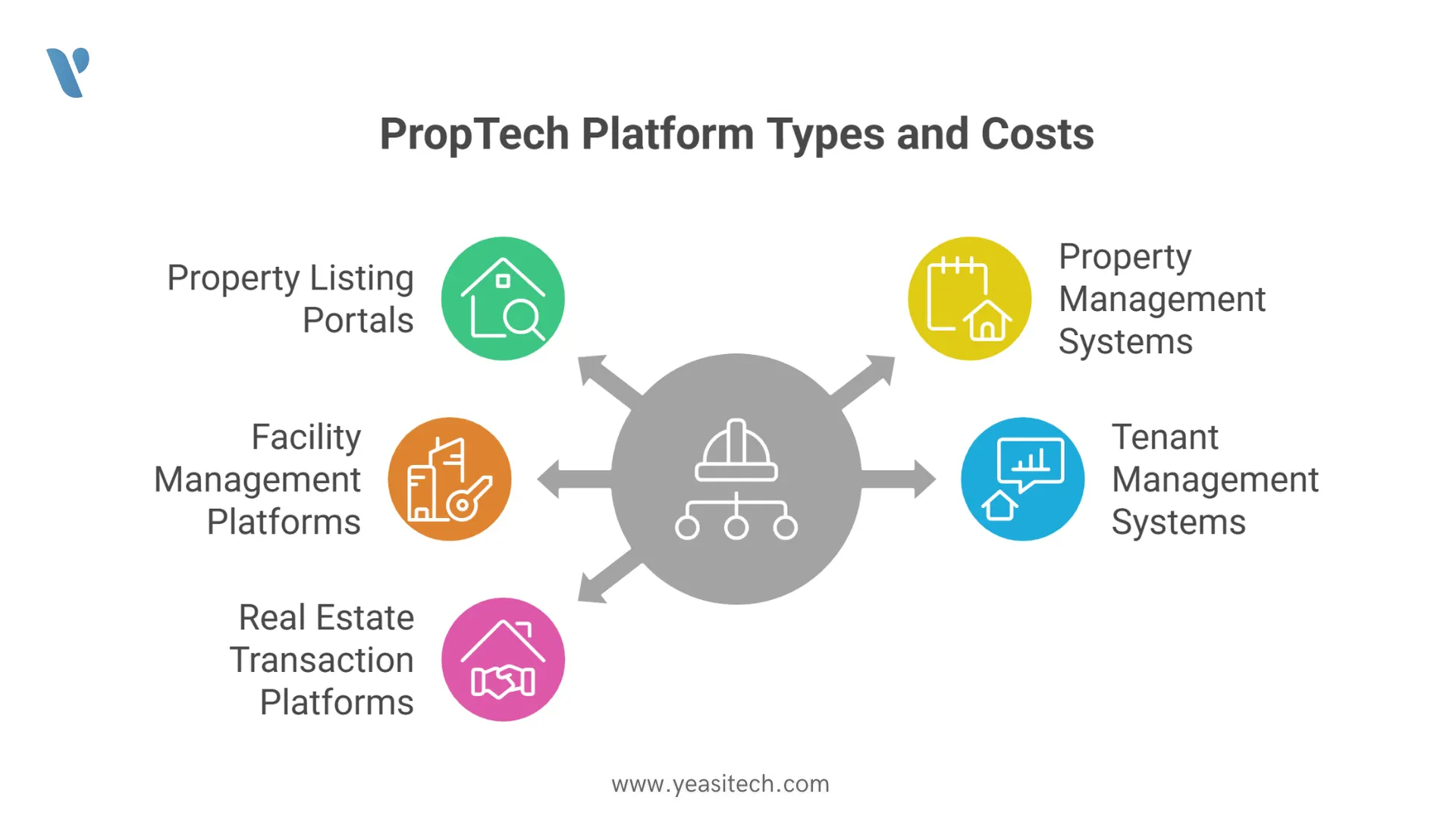
Different real estate software Saudi Arabia solutions serve distinct needs. Understanding the platform types helps you determine which aligns with your business goals – and what it will actually cost to build.
1. Property Listing Portals
Listing platforms connect buyers, renters, and sellers through searchable property databases. Core features include advanced search filters, map integration, property photos and virtual tours, agent contact details, and comparison tools. For the Saudi market, mobile-first design is not optional – the majority of Saudi users browse property on their phones. Look at how Property Finder and Bayut have built listing experiences that regional users trust – your platform needs to feel familiar to that audience while solving a problem they do not.
Essential for Saudi markets: full Arabic and English support, SAR currency handling, mortgage calculators aligned to Saudi banking products, currency conversion for international investors, and integration with the major regional portals.
2. Property Management Systems
Property management software handles day-to-day operations: rent collection, maintenance requests, lease tracking, tenant communication, financial reporting. It is one of the most in-demand categories of real estate software development Saudi Arabia teams are being asked to build, because a lot of property management across the Kingdom is still done by hand.
For Saudi markets specifically: VAT compliance tools for KSA tax regulations, integration with local payment gateways, Arabic and English interfaces, and mobile apps that work properly for both property managers and tenants. Simple systems with basic tenant management and payment tracking start around AED 250,000. Comprehensive platforms with automated workflows, analytics dashboards, and third-party integrations reach AED 650,000.
3. Facility Management Platforms
Facility management tools keep buildings running: work order management, preventive maintenance scheduling, vendor coordination, asset tracking, energy management. For Saudi Arabia’s giga-projects, where a single development can be the size of a small city, this is not back-office software. It is a core operational system that determines whether the building runs well or poorly every day.
Essential features: integration with building management systems common in the region, multi-property and multi-location support, Arabic language support for maintenance staff, mobile apps for technicians that work offline in areas with poor connectivity, and reporting that meets local regulatory requirements.
4. Tenant Management Systems
Tenant management platforms handle the relationship between property owners and occupants: rent payment, maintenance requests, document storage, communication, and community features. The Saudi market has specific expectations. WhatsApp is the communication channel most residents use and expect. Direct debit with local Saudi banks is how tenants prefer to pay rent. Multilingual support matters for Saudi Arabia’s diverse resident population.
Basic platforms with payment processing and communication start around AED 200,000. Advanced systems with community management, smart building integration, and analytics reach AED 500,000.
5. Real Estate Transaction Platforms
Transaction platforms digitise buying and selling: digital contracts, escrow management, document verification, payment processing, and blockchain-based title management. These are the most complex category of custom PropTech software Saudi Arabia developers build – because they need to be secure, connected to government systems, and reliable when large amounts of money are moving through them. Getting any of those three things wrong is not a minor issue.
These platforms require DLD-equivalent API integration for Saudi property registration, blockchain technology for secure transactions, digital signature tools compliant with Saudi regulations, and automated compliance checking. That complexity drives costs up. Here is how development costs compare across all five platform types:
Platform Type
Development Cost (AED)
Timeline
Main Cost Driver
Property Listing Portal
150,000 – 750,000
8-16 weeks
AI recommendations, virtual tours, portal integrations
IoT integration, predictive maintenance, multi-site support
Tenant Management System
200,000 – 500,000
10-18 weeks
Banking integration, multilingual support, community features
Transaction Platform
400,000 – 1,100,000
20-32 weeks
Government APIs, blockchain, security architecture
The cost spread within each type is driven by compliance depth and integration complexity – not feature count.A basic listing portal at AED 150K captures leads. It cannot process legal transactions or connect to government APIs.Choose based on what your users need to actually do on the platform, not just what fits the initial budget.
Saudi Construction Tech Opportunities Under Vision 2030
Most PropTech markets focus on managing existing buildings. Saudi Arabia is different; it is building new ones at a scale that creates demand for tools that barely exist yet. That makes PropTech Saudi Arabia a different kind of market.
1. Massive Infrastructure Investment
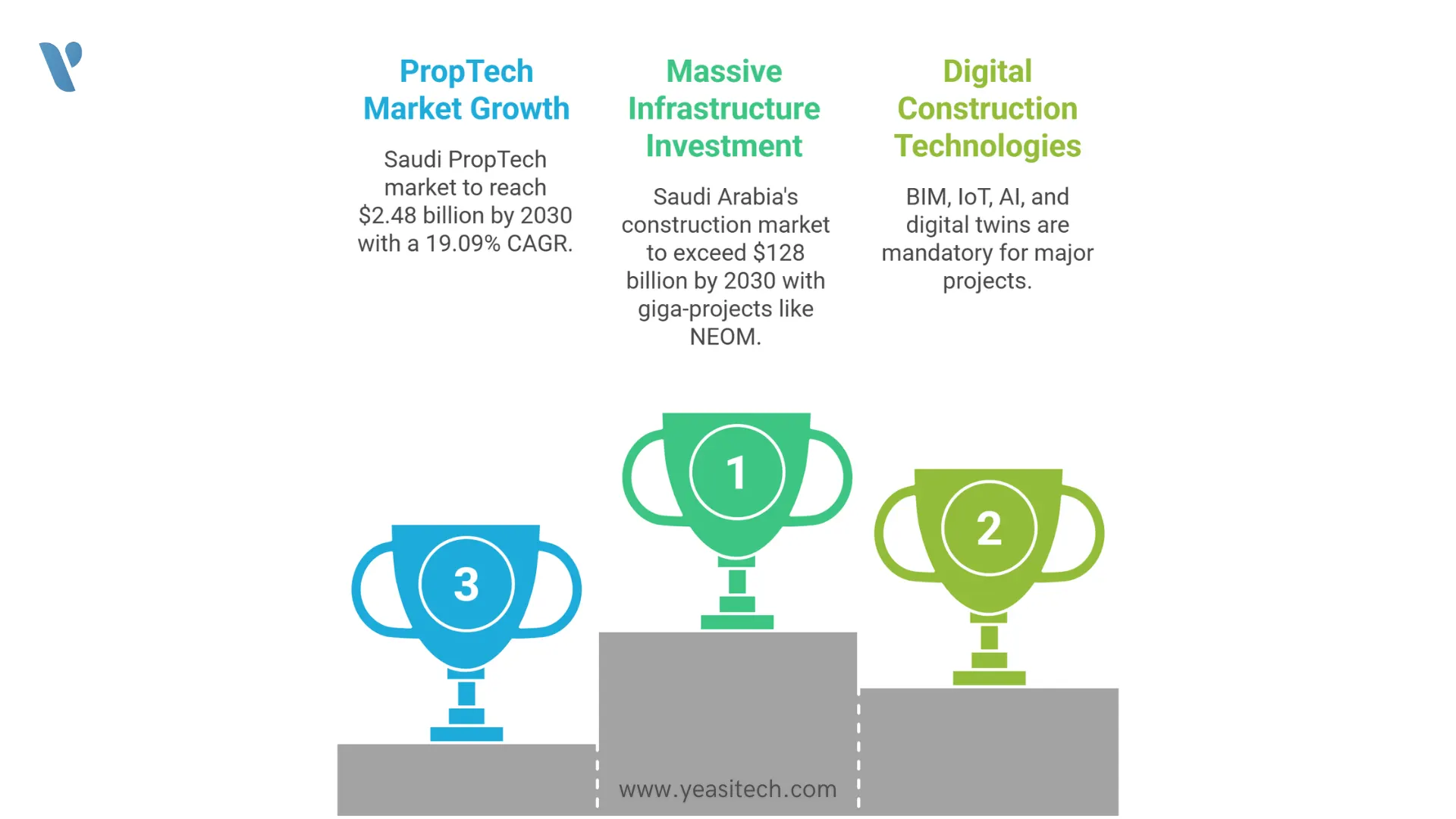
Saudi Arabia’s construction market is projected to hit $62 billion in 2025 and could exceed $128 billion by 2030, according to GlobalData construction market analysis. Over 13 giga-projects are actively under construction, with 5,200+ projects collectively valued at $819 billion.
The flagship NEOM megacity carries a $500 billion budget. The Line – a 170-kilometre linear city within NEOM – is integrating AI infrastructure and IoT systems from the ground up. Qiddiya covers more area than Manhattan. The Red Sea Project spans 50 islands with sustainability systems built throughout. Each of these needs real estate software development Saudi Arabia teams can deliver across the full lifecycle: construction management, facility operations, and tenant engagement.
The specific PropTech opportunities these projects create right now: project management software, BIM collaboration platforms, construction progress tracking, workforce management systems, and quality control applications.
2. Digital Construction Technologies
Saudi Arabia invested over SAR 500 billion ($133 billion) in infrastructure, with a significant portion going specifically to construction technology. Building Information Modeling (BIM) is becoming mandatory for major projects. BIM lets teams plan, simulate, and refine construction in 4D (adding time) and 5D (adding cost) before physical work starts – fewer errors, better budget control.
PropTech platforms offering BIM collaboration, clash detection, and model coordination are in active demand on Vision 2030 projects. If you are thinking about where to focus custom PropTech software Saudi Arabia development, this is a commercial opportunity with funded clients already looking for solutions.
IoT sensors on active Saudi construction sites track equipment use, worker safety, and site conditions today – not in a pilot. AI tools process that data to flag delays early and allocate resources more efficiently. Digital twins let NEOM and similar projects test infrastructure layouts and simulate operations before breaking ground. Augmented reality apps let workers overlay BIM models onto the physical site, catching deviations in real time. As 5G expands across Saudi Arabia, these tools are moving from large-project-only to standard practice.
3. PropTech Market Growth in Saudi Arabia
The PropTech Saudi Arabia market was valued at $860 million in 2024 and is expected to reach $2.48 billion by 2030 at a 19.09% CAGR, according to Mordor Intelligence PropTech report. That growth rate is well above the global PropTech average and reflects how much capital is flowing into the sector.
Riyadh’s 100,000-home commitment is already underway. The SAR 1.25 trillion infrastructure budget is being spent. Each new development creates long-term demand for property management, facility tools, and tenant platforms. This is a funded pipeline, not a speculative forecast.
Essential Features for Saudi PropTech Platforms
Building real estate software Saudi Arabia users will actually pay for means solving Saudi-specific problems. The features below are not generic requirements – they are specific to how the Saudi property market works.
1. Arabic RTL Language Support
Arabic RTL support is a basic requirement for any platform serving Saudi Arabia. But a lot of teams misunderstand what proper RTL implementation means. It is not just translating the text. Your entire interface needs to mirror: navigation, forms, buttons, icons, and content flow all reverse direction for right-to-left readers. Many platforms get the translation right and the layout wrong. That breaks the experience for Arabic users.
What works: hire native Arabic speakers to review every screen, not translators reviewing word lists. Test date formats and number displays – these work differently in Arabic contexts. Make language switching smooth, because many Saudi users regularly switch between Arabic and English within the same session. Build RTL in from the first design sprint. Retrofitting it after launch is one of the most common and avoidable cost overruns in Gulf PropTech projects.
2. Local Payment Gateway Integration
Saudi users and businesses have specific payment preferences that differ from Western markets. Telr, Network International, and PayTabs are the main regional payment gateways with strong Saudi bank relationships and support for local card processing and digital wallets. Apple Pay and Google Pay are widely used in Saudi Arabia and should be supported from launch – smartphone penetration is high and mobile payment adoption is strong.
For recurring rent, integration with Saudi banks for direct debit and standing orders is what tenants and landlords want – it is how the market works. For large property transactions, escrow account support is required, with your payment system tracking deposits, release conditions, and compliance documentation throughout the process. Currency handling for SAR needs to be accurate, with clear conversion tools for international investors.
3. Property Registry API Connections
Saudi Arabia’s Ministry of Justice operates the Aqar platform for property registration. Integrating with Aqar lets your platform verify ownership, confirm title status, and process registration through official channels. Without this, transaction platforms in Saudi Arabia cannot function legally – it is not a nice integration to have, it is a core requirement.
For custom PropTech software Saudi Arabia platforms handling property valuations, Aqar data on historical sale prices, rental rates, and market trends is significantly more reliable than scraped or estimated data. Blockchain integration is also emerging in the Gulf – Dubai launched the region’s first tokenised property through the DLD, enabling fractional ownership and digital real estate trading. Saudi platforms building blockchain-based property records now are ahead of where the market is heading.
4. Smart Building Integration
Saudi Arabia’s newest developments come with smart infrastructure already installed. HVAC control systems, access control platforms, elevator and parking management, energy monitoring tools – these are standard in many Vision 2030 developments, not premium additions. Facility management platforms that connect to these systems give property managers real visibility into what is happening in their buildings.
IoT sensor data tells you occupancy levels, energy consumption, air quality, and equipment status in real time. That data enables predictive maintenance – fixing things before they fail rather than after. For facility management platforms specifically, smart building integration is shifting from a competitive differentiator to a baseline expectation, particularly for NEOM-adjacent developments.
5. BIM and Digital Twin Support
This feature is specific to Saudi Arabia’s construction market and worth calling out separately. Major Vision 2030 projects mandate BIM, and facility management platforms that connect to BIM models let operators track building performance against the original design. For real estate software development Saudi Arabia teams working in facility management or construction tech, BIM and digital twin integration is a genuine market gap – few platforms handle it well, which means the opportunity is open.
Compliance Requirements for Saudi Real Estate Software
Compliance is the area where most real estate software Saudi Arabia projects run into trouble, usually mid-build when fixing things costs two or three times more than doing them right at the start. The five requirements below are non-negotiable for Saudi PropTech platforms.
Requirement
What It Covers
Consequence of Missing It
Aqar Integration
Property registration, ownership transfers, title verification
Platform cannot process legal property transactions
VAT and FATOORAH
15% VAT on transactions, mandatory e-invoicing via ZATCA
Financial penalties, potential shutdown by ZATCA
Saudi PDPL
User data protection, consent flows, breach notification
Fines up to SAR 5 million
AML Regulations
KYC for high-value transactions, source of funds, PEP screening
Criminal liability possible for platform operators
Watheeq Integration
Digital notarisation of real estate contracts
Contracts legally unenforceable in Saudi courts
Technology Stack Recommendations
The right stack for PropTech Saudi Arabia projects needs to do three things well: handle Arabic language support properly, meet Saudi data residency requirements, and connect to government APIs. Here is what works in production.
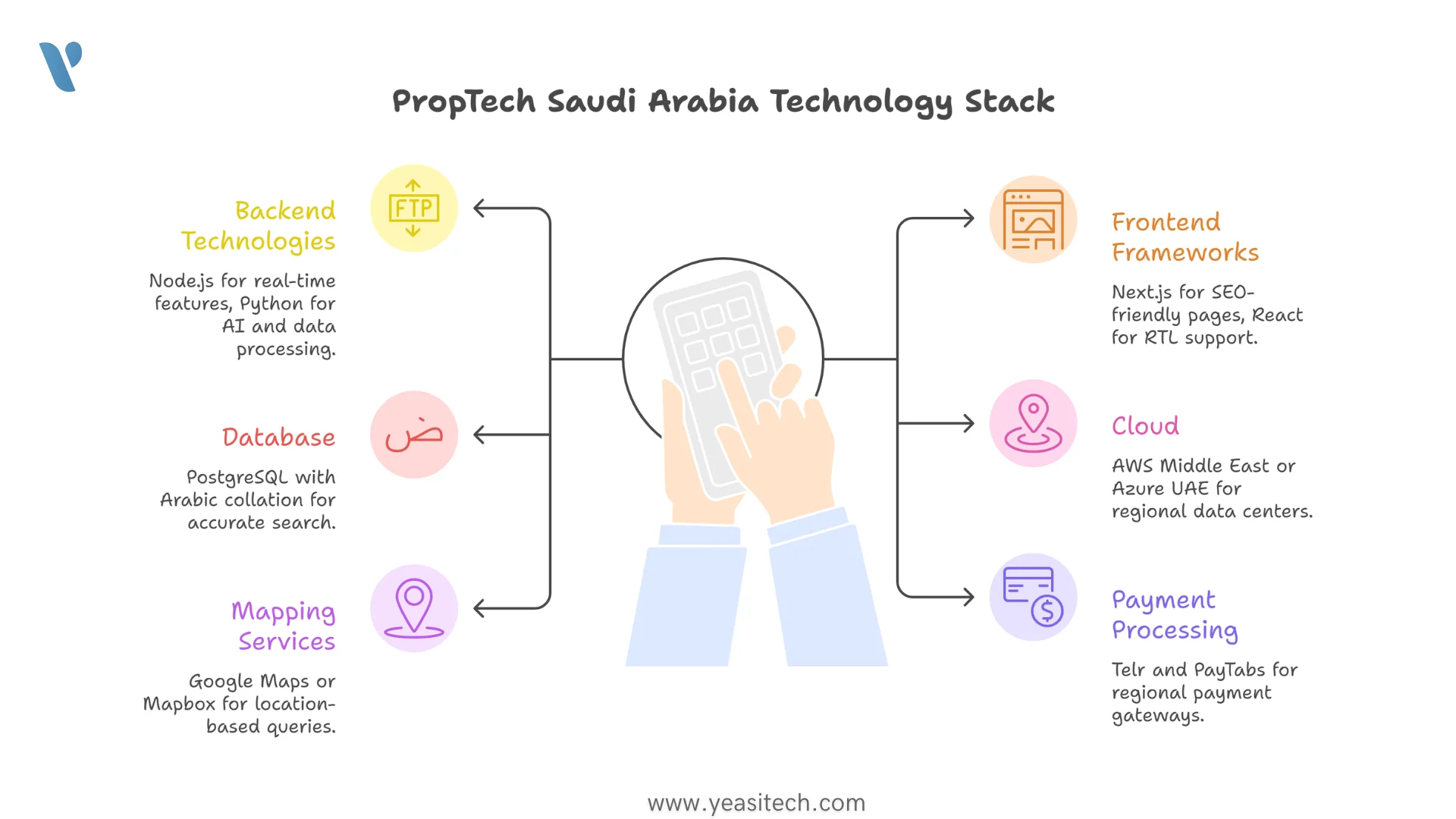
1. Backend Technologies
Node.js handles real-time features well – live property alerts, chat, push notifications. Python is the better choice for AI valuation models and data processing pipelines that analyze Saudi transaction data. Most successful custom PropTech software Saudi Arabia platforms use Node.js for the API layer and Python for background processing, a division of labour that plays to each language’s strengths.
2. Frontend Frameworks
Next.js delivers fast, SEO-friendly property listing pages that rank in Arabic and English search. Server-side rendering is critical for property detail pages – search engines need to index descriptions, prices, and locations to drive organic traffic. Arabic RTL support is native in modern React. Use Tailwind CSS with RTL variants built in from day one, not retrofitted later.
3. Database: PostgreSQL With Arabic Collation
PostgreSQL handles Arabic text correctly with the right collation settings – critical for search accuracy. Enable full-text search with Arabic stemming for property description searches and add the PostGIS extension for location-based queries. Saudi Arabia’s geographical spread across major cities like Riyadh, Jeddah, and NEOM makes location-based queries essential.
4. Cloud: AWS Middle East (Bahrain) or Azure UAE
Saudi data residency regulations push toward regional hosting. AWS Middle East (Bahrain) and Microsoft Azure UAE both provide regional data centres with compliance-ready infrastructure. Benefits beyond compliance: lower latency for Saudi users and easier integration with government APIs that restrict cross-border data transfers. Google Cloud Platform offers strong data analytics capabilities, though its Middle East presence is more limited.
5. Mapping and Location Services
Google Maps dominates the Gulf market with comprehensive Saudi coverage, Arabic language support, and familiar user interfaces. Mapbox provides customizable mapping with excellent developer tools and competitive pricing for high-volume usage. For property boundaries and land parcel data, integration with Saudi government GIS systems provides authoritative information essential for legal property identification.
6. Payment Processing
Telr and PayTabs are the primary regional payment gateways for Saudi markets, with strong local bank relationships and support for SAR transactions. Stripe operates in the UAE but has more limited capabilities in Saudi Arabia – verify current availability before building your payment architecture around it. For subscription billing common in SaaS PropTech platforms, Chargebee and Recurly offer sophisticated multi-currency subscription management.
Development Timeline and Budget Planning
Realistic timelines and budgets for real estate software Saudi Arabia projects – not best-case estimates. The biggest surprises in PropTech development are almost always compliance requirements discovered mid-build and government API integrations that took longer than planned. These numbers account for both.
Depends on user volume and data storage requirements
Software maintenance
5,000 – 7,000
60,000 – 80,000
15-20% of original development cost annually
Payment gateway fees
Variable
2-3% of transaction volume
Per-transaction fee, not a fixed monthly cost
Mapping API charges
500 – 3,000
6,000 – 36,000
Scales with number of map loads and API requests
Customer support staffing
Variable
Depends on user base size
In-house or outsourced support team costs
The biggest budget mistakes in PropTech are not the obvious ones.They are compliance features found mid-build, RTL redesigns after launch, and government APIs that took three times as long as planned.Two weeks of honest discovery upfront is the most reliable way to stay on budget
How YeasiTech Builds Real Estate Software for Saudi Arabia?
Most development agencies take your requirements, build what you asked for, and hand it over. YeasiTech works differently. Building custom PropTech software Saudi Arabia market demands is not a generic software project. It requires domain knowledge, compliance depth, and a process tested against Saudi regulatory requirements before your platform goes live.
Step 1: Discovery Sprint (Weeks 1-2)
Before a single line of code is written, we run a structured discovery sprint. We map your operational workflows against Saudi compliance requirements, identify which government API integrations apply to your platform, flag compliance gaps that would surface mid-build, and produce a detailed specification with realistic cost and timeline estimates broken down by module. Two weeks at the start saves four to six weeks of rework later.
Step 2: Compliance Architecture First
We build compliance into the foundation, not the finishing coat. Saudi PDPL data consent flows, Aqar integration requirements, ZATCA FATOORAH e-invoicing logic, and AML KYC workflows are designed into the system architecture from day one. Retrofitting compliance after a regulatory action costs three to five times more than building it correctly from the start.
Step 3: Arabic-First Development
We do not build in English and translate. We design the interface to support full Arabic RTL from the beginning, with bilingual property descriptions, contracts, and search working natively. Teams without direct Arabic interface experience generate two to three rework cycles on RTL implementation. Our team has built Arabic-first platforms for the Gulf market and treats it as a baseline requirement, not an afterthought.
Step 4: Government API Integration With On-Ground Testing
Aqar, ZATCA, and other Saudi government API integrations require testing against live government sandbox environments. We handle this directly. Our team has navigated the documentation gaps, undocumented edge cases, and testing environments these APIs present. You do not pay for the learning curve. We have already been through it.
Step 5: Launch and Post-Launch Support
We do not hand over code and disappear. Post-launch support covers regulatory updates as Saudi requirements evolve, API version migrations as government systems modernise, and feature additions as your platform grows. Saudi Arabia’s PropTech regulatory environment is developing rapidly. Your platform needs a development partner who tracks those changes.
Conclusion
Saudi Arabia is building new cities, residential districts, and commercial developments at a scale the region has not seen before. All of those buildings need software to manage them. Real estate software development Saudi Arabia teams can deliver – management systems, facility platforms, transaction tools, tenant apps – is in demand at every level of the market.
The PropTech Saudi Arabia market is growing at 19.09% annually, backed by government budgets already committed and projects already under construction. The question is not whether the demand is real. It is whether your platform is positioned to meet it.
Building real estate software Saudi Arabia market actually needs means solving Saudi-specific problems: Aqar integration, VAT compliance, Arabic-first design, BIM connectivity, smart building integration. These need a team that knows them from experience, not from reading about them.
YeasiTech offers a free consultation to map your requirements against Saudi compliance, recommend the right technology stack, and give you a realistic cost and timeline estimate based on your actual business – not a formula. Book your free consultation at YeasiTech.
FAQs
1. What is PropTech Software Development?
PropTech (property technology) software builds digital tools for buying, selling, renting, and managing real estate. For PropTech Saudi Arabia, this includes listing portals, property management systems, facility platforms, tenant engagement tools, and transaction software. It combines real estate knowledge with software engineering, cloud infrastructure, mobile apps, and technologies like AI, IoT, and blockchain to solve specific property industry problems.
2. How much does it cost to build a PropTech platform in Saudi Arabia?
Costs for real estate software development Saudi Arabia range from AED 150,000 for a basic listing portal to over AED 1,100,000 for a full transaction platform with blockchain integration. Property management systems cost AED 250,000 to AED 650,000. Facility management platforms run AED 300,000 to AED 800,000. The main cost drivers are government API integrations, compliance depth, Arabic RTL implementation, and the experience level of your development team. See the full cost breakdown table in Section 2 above.
3. What compliance requirements must Saudi PropTech platforms meet?
Saudi real estate software Saudi Arabia platforms must integrate with Aqar for property registration, comply with ZATCA FATOORAH for e-invoicing, meet Saudi PDPL data protection standards with fines up to SAR 5M, follow AML regulations for high-value transactions, and use Watheeq for digital contract notarisation. Missing any of these means your platform either cannot process transactions legally or faces significant financial penalties.
4. How long does it take to develop a property management system in Saudi Arabia?
A comprehensive property management system takes 6 to 12 months from start to launch. That includes 2-4 weeks for discovery and planning, 4-8 weeks for design, 12-20 weeks for backend development, 10-16 weeks for frontend and mobile, 4-6 weeks for testing, and 2-4 weeks for deployment. Simpler platforms can go live in 4-6 months. Platforms with extensive government integrations and smart building connectivity may take 12-18 months.
5. What technologies are used in Saudi PropTech platforms?
Most custom PropTech software Saudi Arabia platforms use Node.js or Python for the backend, React or Next.js for web, React Native or Flutter for mobile, and PostgreSQL or MongoDB for databases. Cloud hosting on AWS Middle East (Bahrain) or Azure UAE covers data residency requirements. Payment integration uses Telr or PayTabs. Advanced platforms add AI for valuations, IoT for smart buildings, and BIM tools for construction project integration.
6. Do I need Arabic language support for Saudi real estate apps?
Yes – and proper RTL support, not just translated text. Your entire interface must mirror for right-to-left use: navigation, forms, buttons, icons, content flow all change direction. Use native Arabic speakers to review every screen. Test date and number formats that work differently in Arabic. Build RTL from the first design sprint. Retrofitting it after launch is one of the most common and avoidable cost overruns in Gulf PropTech projects.
7. What is DLD integration and why does it matter?
DLD (Dubai Land Department) integration connects PropTech platforms with Dubai’s official property registration and transaction systems. The Saudi equivalent is Aqar integration with the Ministry of Justice. Both enable property ownership verification, transaction tracking, and automated compliance checking. For companies building across both markets, read our Dubai PropTech development guide for the full DLD integration picture.
8. Does YeasiTech build PropTech platforms for Saudi Arabia?
Yes. YeasiTech builds real estate software development Saudi Arabia market clients need including property management systems, facility platforms, transaction tools, and listing portals. We know Saudi compliance – Aqar, ZATCA FATOORAH, Saudi PDPL, AML – and build it into the architecture from day one, not as an afterthought. Book a free consultation at yeasitech.com/contact-us.
Ready to Build Real Estate Software for Saudi Arabia?Free 60-minute consultation. Specific to your platform, your compliance needs, your budget:
What we cover:Your platform requirements mapped against Aqar, ZATCA, Saudi PDPL, and AML. Technology stack recommendations for the Saudi market specifically. Timeline and cost breakdown by module – real numbers, no formula estimatesHonest advice on whether to build from scratch or adapt an existing platform